 +91-9784559999
 info@thournatureresorts.com
Somewhere between 50 and 70 leopards are estimated to live in and around Jawai, based on figures cited by the Rajasthan Forest Department and repeated across wildlife and tourism sources covering the region. There’s no single, publicly published census document pinning the number down to the animal, Jawai’s leopards aren’t confined behind a fence, so an exact real-time count isn’t really possible but that range is the consistent, credible figure you’ll hear from guides, naturalists, and forest officials alike.
What makes that number remarkable isn’t the count itself; plenty of Indian forests hold more leopards. It’s the density, packed into granite hills with almost no tree cover, living in the open alongside working villages, that has led wildlife writers to call Jawai one of the highest concentrations of non-forest-dwelling leopards anywhere in the world.
Quick summary
- The number: roughly 50–70 leopards, an estimate rather than a hard census count.
- Why it’s notable: not the total, but the density — leopards living in open granite country with almost no tree cover.
- Legal status: Jawai Bandh Leopard Conservation Reserve, notified 23 February 2010. Not a national park.
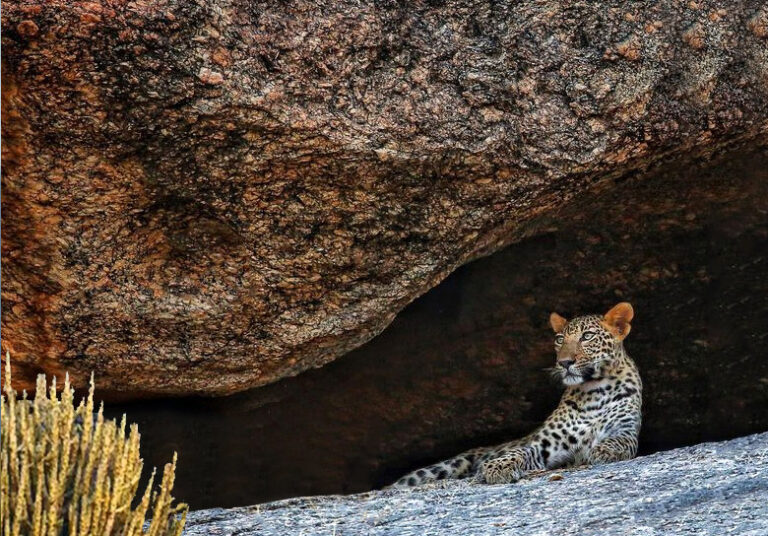
- Why they’re visible: they den in caves and rock clefts instead of trees, and hunt from exposed boulders.
- Sightings: genuinely strong odds on a dawn or dusk drive — but never guaranteed by anyone honest.
In this guide
- Jawai Leopard Population: Quick Facts
- Is Jawai an Official Leopard Reserve?
- Why Jawai’s Leopards Behave Differently
- Territory and Density
- What Jawai’s Leopards Actually Hunt
- Living Alongside Leopards: The Rabari Connection
- Beyond the Leopards
- Jawai vs. Jhalana
- Conservation Pressures Worth Knowing
- Frequently Asked Questions
Jawai Leopard Population: Quick Facts
| Estimated population | 50–70 leopards |
| Legal status | Jawai Bandh Leopard Conservation Reserve |
| Notified | 23 February 2010 (extended 2018) |
| Core area | ~19.79 sq km at notification |
| Governing body | Rajasthan Forest Department |
| District | Pali, Rajasthan |
| Terrain | Granite hills, boulders, caves (Aravalli Range) |
| Habitat type | Non-forest, cave-and-crevice dwelling |
Is Jawai an Official Leopard Reserve?
Yes, and this is worth getting right, because a lot of tourism content gets it wrong in both directions. Jawai is not a national park or tiger reserve. It is the Jawai Bandh Leopard Conservation Reserve, notified by the Rajasthan Forest Department on 23 February 2010 under the Wildlife Protection Act, initially covering roughly 19.79 sq km around the dam. A second notification in 2018 extended protected status to additional surrounding villages and forest land as the leopard population’s range became better understood.
“Conservation Reserve” is a distinct legal category from a national park or sanctuary looser on core-zone restrictions, built specifically to protect a landscape where wildlife and human settlement already coexist, which is exactly what Jawai is.
Why Jawai’s Leopards Don’t Behave Like Other Leopards
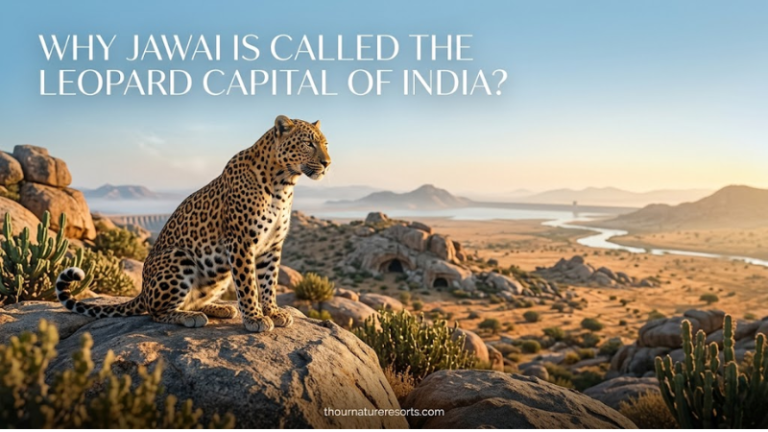
In central India’s forests, a leopard’s world is vertical; trees for cover, trees for the kill, trees to disappear into when a jeep rolls past. Jawai has almost none of that. The Aravallis here, among the oldest hill ranges on the planet, have worn down to bare granite: boulders stacked like they were dropped from a great height, caves, crevices, the odd stunted acacia. There’s no canopy to hide a hunt.
So the leopards adapted. They den in the granite caves and rock clefts instead of trees, and they hunt the way a hawk might rather than a jungle cat perched on an exposed boulder at dusk, scanning the scrub below, choosing their moment before they move. Guides who’ve spent years here will tell you it’s less like tracking an animal and more like reading a neighbor’s routine: which ledge a particular cat favors at sunset, which cave mouth catches the last light. It’s this visibility, not a large fenced sanctuary that makes sightings on a Jawai safari genuinely good, though never guaranteed. Any leopard is still a leopard, and wild animals keep their own schedule.
How Leopards Divide the Hills: Territory and Density
Leopards are solitary and territorial by nature, and Jawai’s terrain happens to suit that instinct well. The granite hills break the landscape into natural compartments: a ridge here, a boulder field there, which lets adult leopards hold overlapping but distinct home ranges without constant confrontation. As is typical of the species elsewhere in India, adult males tend to claim the larger territories, while females settle into smaller ranges built around a denning site, and sub-adults eventually disperse outward once they’re independent, drifting toward Jawai’s fringes or beyond in search of unclaimed ground.
That dispersal matters more than it sounds. It’s the mechanism that keeps a landscape like Jawai from overcrowding on its own and forest officials and researchers who study leopard populations elsewhere in India generally point to exactly this kind of natural spacing as the sign of a functioning, self-regulating population rather than a static headcount.
What Jawai’s Leopards Actually Hunt
For an apex predator with this much of a following, Jawai’s leopards eat fairly ordinary fare. Guides and regional wildlife accounts consistently describe peafowl, langurs, and wild boar as the backbone of the diet here, with chinkara and other small ungulates taken where available, and livestock predation happening on occasion, usually goats or sheep grazing near the hills. Our closer look at how Jawai’s leopards hunt covers the mechanics in more detail.
None of this is exotic; it’s the standard opportunistic diet of an Indian leopard adapted to a mixed wild-and-pastoral landscape, which is precisely what makes Jawai’s ecosystem work as well as it does. A stable prey base keeps leopards from relying on livestock as their default food source, which in turn keeps conflict with the Rabari lower than you’d expect given how closely the two share this ground.
Living Alongside Leopards: The Rabari Connection
None of this would work without the Rabari, the semi-nomadic pastoral community who’ve herded goats, sheep, and camels across this land for generations, recognizable by white dhotis and deep maroon turbans, by women in heavily embroidered dress and silver jewelry. This isn’t a community that tolerates leopards despite the risk to their herds; the coexistence here runs deeper than that.
Many Rabari are devotees of Shiva, who is traditionally depicted wearing a leopard or tiger skin, and the big cats are regarded locally as sacred, protector figures with a direct link to the deity. It’s a common sight to find a small stone leopard idol at a village shrine, standing guard the way the leopards themselves are believed to watch over the hills. Livestock loss does happen; a goat taken here, a sheep there and while herders can seek compensation through state wildlife-damage schemes, the tolerance itself is rooted in faith more than payout. Ask a Rabari elder why they don’t retaliate, and the answer rarely mentions money at all.
What you won’t hear, credibly, is any claim that leopards have never once come into conflict with people in this landscape, wild predators and open villages sharing the same rock don’t add up to a zero-incident history. What’s true, and remarkable, is how rare serious conflict is, given the proximity.
Beyond the Leopards: Jawai’s Wider Wildlife
Leopards get the headlines, but Jawai Dam is one of the larger reservoirs in western Rajasthan, and the reason this ecosystem exists at all pulls in a wide cast of other species. Winter turns the dam’s shallows into a stopover for migratory birds: flamingos, cranes, pelicans, and assorted waterfowl working the mudflats. Marsh crocodiles bask along the banks. Striped hyenas and jackals move through the scrub after dark, and monitor lizards work the rocks by day.
It’s a landscape built for patient watchers as much as leopard-spotters pack the binoculars along with the long lens.Our field guide to the animals found in Jawai runs through the full cast.
Jawai vs. Jhalana: How the Two Compare
Jawai isn’t Rajasthan’s only leopard destination, and it’s worth knowing how it stacks up.
| Jawai | Jhalana | |
|---|---|---|
| Size | ~19.79 sq km core, unfenced beyond | ~20–23 sq km, bounded |
| Leopards | ~50–70 | ~30–40 |
| Location | Rural Pali district, granite hills | Inside Jaipur city |
| Safari style | Tracking-led, no fixed routes | Fixed routes, defined core zone |
| Best for | Scale, atmosphere, pastoral culture | Compact trips, sighting consistency |
If Jhalana is leopards in a reserve, Jawai is leopards in a working landscape that happens to include a reserve. Neither is “better” outright; they’re suited to different kinds of trips.
Conservation Pressures Worth Knowing About
Jawai’s success story isn’t guaranteed to hold indefinitely. Rising tourism traffic, expanding resort and road infrastructure around the dam, and gradual habitat fragmentation as villages grow are all cited by conservationists as long-term risks to a landscape that has functioned, until now, mostly without hard boundaries.
None of this is a crisis, the population here has proven resilient but it’s the reason regulated safari numbers, responsible operator practices, and continued forest department oversight matter as much to Jawai’s future as the granite hills themselves. A landscape that protects wildlife through coexistence rather than fencing only keeps working if that coexistence is actively maintained, not assumed.
Where to See It All From: Jawai Dam and Beyond
If you want the whole picture in one frame, the causeway and hills around Jawai Dam give you it: granite catching the evening light, water stretching out toward the horizon, and somewhere on a ridge, if you’re patient and a little lucky, a leopard deciding where to hunt tonight. It’s one of those views that photographs well and still undersells the real thing.
Frequently Asked Questions
Is Jawai a national park?
No, Jawai is legally notified as the Jawai Bandh Leopard Conservation Reserve, a distinct protection category from a national park or tiger reserve, managed by the Rajasthan Forest Department.
What is the best time to see leopards in Jawai?
Winter months from October to March are generally considered the most comfortable for safaris, with dawn and dusk drives offering the best chance of activity, since that’s when leopards are typically most active. Summers in this part of Rajasthan get extremely hot.
Are Jawai’s leopards dangerous to visitors?
They’re wild predators, not tame animals, and should always be treated that way but serious incidents involving visitors or villagers are rare given how long humans and leopards have shared this landscape. Sightings happen from a safe distance on guided safaris, never on foot near dens or resting sites. Our guide on whether Jawai is safe for a leopard safari covers this in full.
Is a leopard sighting guaranteed in Jawai?
No reputable operator should promise a guaranteed sighting; these are wild, free-ranging animals. That said, Jawai’s open terrain and high density make the odds genuinely strong compared to most forested reserves.
Experience It From Thour Nature Resorts Jawai
At Thour Nature Resorts Jawai, our safaris run at dawn and dusk, the hours when the hills actually move, when a langur’s alarm call might mean nothing or might mean everything. Our guides have spent years learning these hillsides the way the Rabari have: not as tourists, but as people who’ve watched the same ledges long enough to know their regulars.
Stay in our Luxury Tents, and Cottages close enough to the granite that you’ll hear Jawai before you see it, with soft linen and hot water waiting at the end of a dusty afternoon in the field. Book your Jawai leopard safari online and come see why this stretch of the Aravallis has been leopard country for as long as anyone can remember.