 +91-9784559999
 info@thournatureresorts.com
Quick Summary
- Jawai Bandh history: The dam project began in 1946 under Maharaja Umaid Singh of Jodhpur, decades after severe flooding on the Jawai River in 1903 first prompted the proposal.
- Why the dam was built: The project was intended to create a reservoir supporting irrigation, water supply and a proposed hydroelectric power project.
- Jawai’s landscape: Ancient granite hills and caves surround the reservoir and have become an important part of Jawai’s distinctive leopard habitat.
- Rabari culture: The Rabari pastoral community has a deep cultural presence in the Jawai region and is closely associated with its human-leopard coexistence.
- Jawai today: The reservoir, granite hills, wildlife and pastoral culture have made Jawai an important wildlife and tourism destination in Rajasthan.
- Experience Jawai: Thour Nature Resorts Jawai provides accommodation and access to Jawai safari experiences amid the region’s granite landscape.
In This Guide
01 Why the Dam Was Built 02 Jawai Dam by the Numbers 03 Rich History of the Jawai Area 04 The Rabari: A Living Culture, Not a Backdrop 05 Where the Story Leads: Jawai Today 06 Frequently Asked Questions
Say the word “Jawai” to anyone who has been there and the leopards come up first, draped over sun-warmed granite with the Rabari herders below. But the cats are a relatively recent chapter in this landscape’s story.
Few pockets of Rajasthan pack in this much at once. There is the geology. The granite hills here are among the oldest exposed rock on the planet, riddled with caves that give leopards cover without a single tree.
There is the water. A reservoir turned a flood-prone stretch of semi-arid Rajasthan into a lifeline for Pali district’s farms and villages, and it now serves as a winter stopover for migratory flamingos, cranes and pelicans.
And there is the human story of the Rabari, whose relationship with the leopard has made this one of the few places on earth where a big cat and a herding community have shared the same ground for generations.
That combination of ancient rock, working water, wild predator and living pastoral culture is why Jawai has become one of India’s most talked-about wildlife destinations.
The land itself, and the dam that reshaped it, carry a longer story. It runs from Vedic-age sages to a 1946 engineering project.
Here is that story, including what is documented, what is legend, and where the two blur, as they tend to in Rajasthan.
If you want to understand Jawai beyond its history, you can also explore our Jawai Bandh Rajasthan guide for more about the destination and its landscape.
Why the Dam Was Built
Jawai Bandh sits across the Jawai River, a tributary of the Luni, in the Pali district of Rajasthan, near Sumerpur.
The Jawai’s monsoon flooding severely damaged the Pali and Jalore districts in 1903, which prompted the proposal to build a dam across it. More than four decades passed before work actually began.
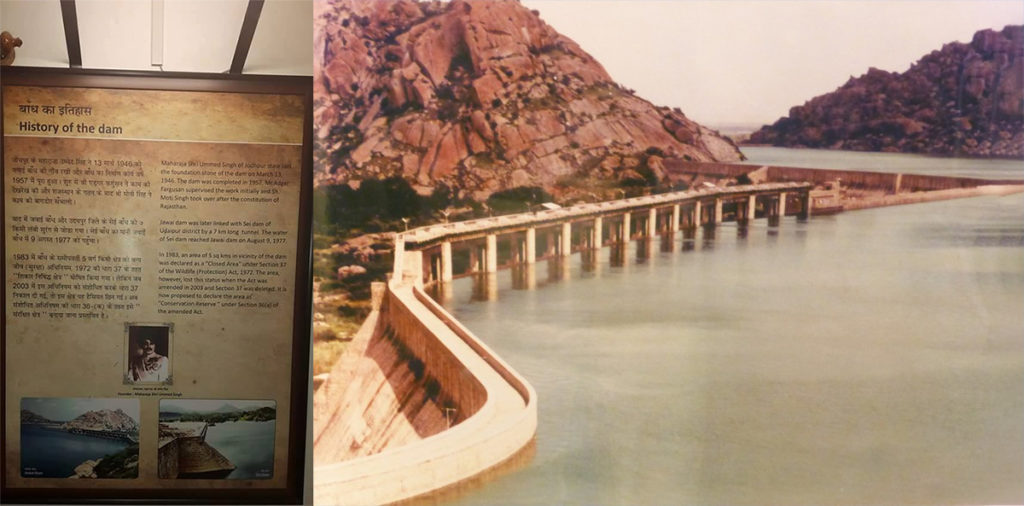
In 1946, Maharaja Umaid Singh of Jodhpur began construction. Until then Jawai was a stretch of granite hills and a seasonal river, of little interest to anyone but the herders who worked it.
The project was planned to serve two purposes. It would create a water reservoir for agriculture and water supply, and it would generate hydroelectric power.
Work began on 12 May 1946. By the time India’s First Five Year Plan was launched in 1951, over 124 lakh rupees had already been spent on the project.
The hydroelectric component was eventually shelved, because the water pressure it needed was not reliably available through the year. The irrigation and water-supply objectives held.
Construction wrapped up in 1957, after an eleven-year build.
Jawai Dam by the Numbers
What Maharaja Umaid Singh’s engineers built remains, decades later, the largest man-made dam in western Rajasthan.
| Feature | Details |
|---|---|
| Surface Area | 13 sq. km |
| Storage Capacity | 7,887.5 million cubic feet (M.CFT) per Rajasthan Water Resources Department figures. The Central Water Commission lists a gross capacity of 207.5 MCM. |
| Command Area | 102,315 acres of cultivable land (about 414 sq. km) |
| Height | Approximately 18.67 m (61.25 ft). The Rajasthan Water Resources Department lists a foundation height of 51 m. |
| Catchment Area | Approximately 720 sq. km, fan-shaped |
| Feeder Dams | Sei Dam and Kalibor Dam |
This is the primary water source of Pali district, and in good monsoon years it extends irrigation supply to villages in Jalore district as well. That was the same objective that put the project on the table back in 1903.
Rich History of the Jawai Area
The granite hills around Jawai predate the reservoir by a considerable margin. Geologists place them among some of the oldest exposed rock formations in the world, part of the Aravalli range’s ancient geology.
Long before anyone thought to dam the river, this was already a landscape with a reputation. Vedic-age tradition holds that the sage Maharishi Javali retreated here for meditation, and some accounts trace the name “Jawai” back to him, though this etymology is more legend than settled fact.
Regional lore also places the Pandavas here for a stretch of their exile, drawing on the Mahabharata.
Regional histories record that in 120 AD, King Kanishka, during the Kushana period, took the Rohat and Jaitaran areas that form part of today’s Pali district.
By the close of the 7th century AD, the region fell under Harshavardhana, the powerful north Indian emperor of the Pushyabhuti dynasty.
The centuries that followed brought repeated Rajput resistance against successive invasions. The Rathores of Marwar held Pali and its surrounding territory through the 16th and 17th centuries, and it was Veer Durgadas Rathore who, late in that stretch, led the long campaign to reclaim Marwar from Mughal control.
During the 1857 uprising, the Thakurs of Pali, led by the Thakur of Auwa, took up arms against British rule. The resistance held out for several days before the fort at Auwa fell.
The region’s other long story belongs to the Rabari, the pastoral community whose presence here runs just as deep. Their own origins are debated. Some scholars trace a migration from Iran through Afghanistan and Baluchistan, while others argue for a connection with the Rajputs of Rajasthan. Neither account is settled.
The Rabari: A Living Culture, Not a Backdrop
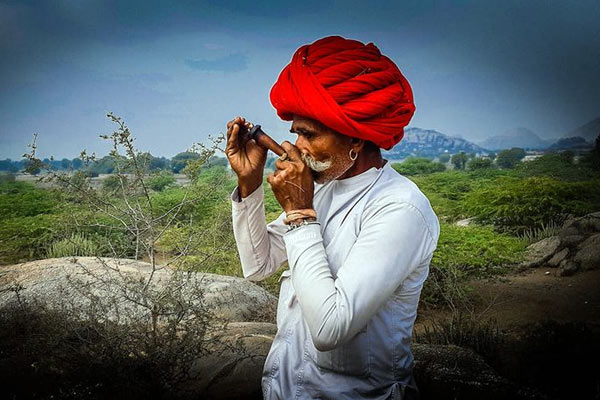
No history of this region is complete without the Rabari, the semi-nomadic pastoral community whose presence around Jawai runs deep. Their coexistence with leopards is the reason this landscape draws visitors at all today.
Their origin stories are woven into Shaiva mythology. One holds that Parvati gathered the dust and sweat from Shiva’s body and shaped it into a camel, a strange five-legged creature that promptly ran off.
To bring it back and care for it, she created the first Rabari, called Sambad in most tellings, and Shiva later folded the camel’s fifth leg into the hump it carries today. Having been made by the goddess, the community reveres her, and her presence runs through their rituals to this day.
Women carry considerable weight in Rabari social and household decision-making, more than is typical in the region, though the community’s kinship structure itself is not matrilineal.
These myths point to a way of life that is still built around animals, movement and herds, in a landscape that has never fenced any of it off.
That helps explain the local attitude toward leopards. Instead of being trapped or driven off after preying on livestock, they are regarded as sacred protector figures linked to Shiva. Livestock losses do happen, and they are generally tolerated.
That tolerance is rooted in belief rather than in policy or fencing, and it is a large part of why Jawai supports the leopard population it does. Estimates range from roughly 50 to 70 individuals depending on the survey cited, among the highest densities of leopards living outside dense forest anywhere in the world.
The leopards of Jawai are, and remain, wild animals. The coexistence here is built on mutual avoidance and cultural restraint.
The hills around the dam are protected as the Jawai Bandh Leopard Conservation Reserve, formally notified by the Rajasthan Forest Department on 23 February 2010 under Section 36A of the Wild Life (Protection) Act, 1972. The core reserve covers 19.79 sq. km around Jawai Dam, and a second notification on 15 June 2018 extended the boundary to take in additional villages. A conservation reserve is a legally distinct category from a national park or wildlife sanctuary. There are no forest-department gates, no fixed safari zones and no boundary walls, and villages, livestock and leopards share the same ground.
Where the Story Leads: Jawai Today
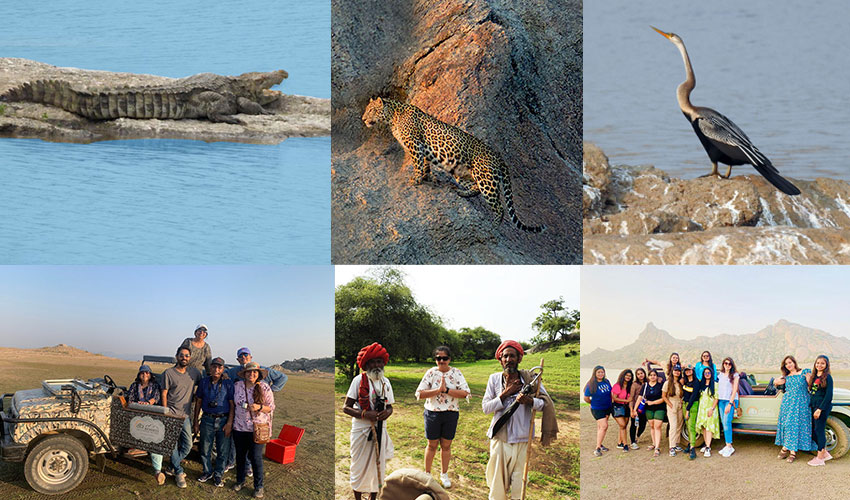
The dam was built to hold back floodwater, and it ended up creating a reservoir and a surrounding granite wilderness that today draws wildlife photographers, birders and travellers hoping for a leopard sighting.
Sightings are never guaranteed anywhere, but the open granite terrain here gives unusually good odds of watching these cats in their own surroundings, on their own schedule.
There is also the winter migratory birdlife and a substantial marsh crocodile population. A 2020 census recorded 377 crocodiles in the dam. Beyond leopards, the reserve and the surrounding landscape support striped hyenas, jungle cats, sloth bears, nilgai, chinkara, Bengal foxes, Indian eagle-owls and reptiles including Indian rock pythons and red sand boas. All of it sits in rocky terrain shared, uneasily but peacefully, between predator and pastoralist. This is the Jawai that exists because of the Jawai that came before it.
If you are interested in experiencing Jawai’s wildlife beyond its history, explore our guide to the Jawai Bandh safari.
You can also learn more about the wider wildlife of the region in our guide to animals found in Jawai.
Frequently Asked Questions About Jawai Bandh
When was Jawai Bandh built?
The proposal followed severe monsoon flooding on the Jawai River in 1903, but construction only began on 12 May 1946, under Maharaja Umaid Singh of Jodhpur. The project was completed in 1957, after an eleven-year build.
Who built Jawai Bandh?
Jawai Bandh was built under Maharaja Umaid Singh of Jodhpur, who began construction in 1946. The dam is today owned and operated by the Rajasthan Water Resources Department, and it remains the primary water source for Pali district.
Is Jawai a national park?
No. Jawai is often called a national park, but it is not one. It is the Jawai Bandh Leopard Conservation Reserve, notified on 23 February 2010 under Section 36A of the Wild Life (Protection) Act, 1972, which is a legally distinct category from a national park or wildlife sanctuary. The core reserve covers 19.79 sq. km, and a second notification on 15 June 2018 extended the boundary. There are no forest-department gates, no fixed safari zones and no boundary walls, and villages, livestock and leopards share the same landscape.
How big is Jawai Dam?
Jawai Dam covers a surface area of about 13 sq. km and serves a cultivable command area of 102,315 acres, roughly 414 sq. km. Its catchment area is approximately 720 sq. km and is fan-shaped. It is the largest man-made dam in western Rajasthan.
Who are the Rabari of Jawai?
The Rabari are a semi-nomadic pastoral community found across Rajasthan and Gujarat, with a long-standing presence around Jawai. Many are devotees of Shiva, and leopards are respected in local religious tradition. That belief underpins an unusual degree of tolerance toward the cats, even when livestock is lost.
Experience Jawai with Thour Nature Resorts Jawai
At Thour Nature Resorts Jawai, we sit inside this story. Our Luxury Tents, Cottages and Spacious Cottages look out toward the same granite hills that have sheltered leopards and Rabari herds for generations.
Our safaris are led by people who grew up reading this landscape and who know which ledge catches the late sun and which alarm call is worth turning the jeep around for. Drives run at dawn and dusk, when the cats are moving.
Evenings tend to end at the hilltop pool, with the hills going dark around you and the day’s sightings still being argued over.
The food is grown here. We cultivate the vegetables and cereal on site and cook them the same day.
Planning your visit? You can also learn how to reach Jawai Bandh by road, rail and air.
Ready to see this history for yourself? Book your stay at Thour Nature Resorts Jawai and experience Jawai’s granite hills, its leopards, and its centuries of story firsthand.
Experience Jawai’s Living History
Explore Jawai’s granite hills, wildlife, water landscape and living pastoral culture with a stay at Thour Nature Resorts jawai.