 +91-9784559999
 info@thournatureresorts.com
Quick Summary
- Why Jawai is famous: Open granite hills, high leopard visibility, and a long-standing coexistence between leopards and Rabari pastoral communities.
- Conservation status: Jawai is protected as the Jawai Bandh Leopard Conservation Reserve, with the core area notified in 2010 and expanded in 2018.
- Best safari season: October to March offers the most comfortable weather, while April to June can provide productive leopard sightings around water sources.
- What you may see: Leopards, striped hyenas, jackals, jungle cats, mugger crocodiles, monitor lizards, and migratory birds around Jawai Dam.
- Safari experience: Open gypsies with local trackers provide a wildlife experience in a natural, unfenced landscape.
- Where to stay: Thour Nature Resorts offers Luxury Tents, Cozy Cottages, Spacious Cottages, a hill-top pool, and access to Jawai safari experiences.
In This Guide
01The Landscape That Makes This Possible
02What Actually Makes Jawai’s Leopards Different
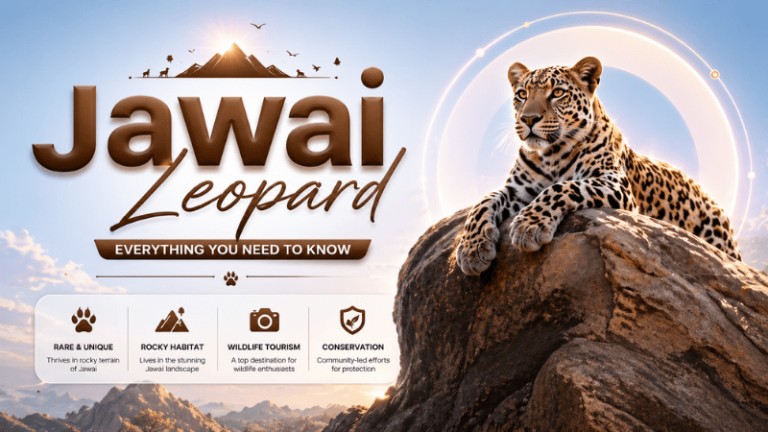
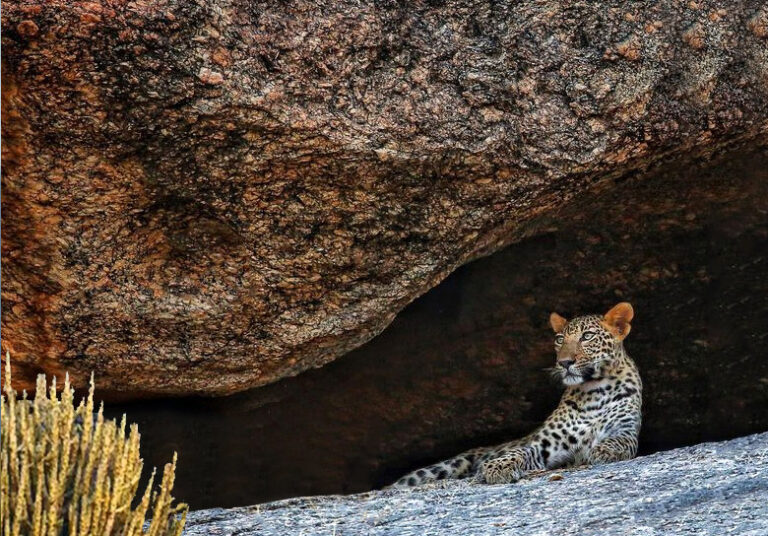
Ask why Jawai has the reputation it does, and the honest answer isn’t a park boundary or a conservation designation; it’s the near-total absence of one. There’s no dense forest here, no gate you queue at for a timed entry slot, no tree cover for a leopard to vanish into. Just bare granite hills in Rajasthan’s Pali district, where these cats rest on open rock in daylight and a Rabari herder a few hundred metres off barely looks up.
That combination of visibility without captivity, density without a forested park is why Jawai has earned its reputation as one of India’s best places to see a wild leopard, widely known in travel circles as “the Leopard Capital of India.” It isn’t an official government title, but it’s a description that shows up consistently and independently across wildlife writers, tour operators, and conservationists which is a different, and more credible, kind of endorsement than a single marketing claim.
The Landscape That Makes This Possible
Jawai sits in Pali district, centered on Jawai Dam, along the edge of the Aravalli range among the oldest hill systems on Earth. Rather than dense jungle, the terrain is weathered granite: boulders, ridgelines, and cave systems that leopards use for shelter, denning, and raising cubs. That’s a meaningfully different habitat from a place like Ranthambore, and it’s why the two destinations offer such different kinds of safaris rather than one being a straightforward substitute for the other.
Worth being precise about: Jawai has no National Park or Wildlife Sanctuary status but it isn’t unprotected. Since 23 February 2010, the core area has held legal status as the Jawai Bandh Leopard Conservation Reserve, under the Rajasthan Forest Department, with a second notification in 2018 (Reserve II) extending coverage across more villages in the Bera, Sena, Jeevda, and Mori belt. “Conservation Reserve” is a genuine legal category under India’s Wildlife Protection Act distinct from, and less restrictive than, a national park, but a real designation with a real notification date, not an informal label.
That protection is also tightening. In May 2026, following a public interest litigation over unregulated tourism and habitat pressure, the Rajasthan High Court directed the Forest Department to roll out a stricter Standard Operating Procedure across the reserve: safari vehicles will need to register with a new Jawai Safari & Eco Tourism Coordination Committee and carry forest-department-approved GPS trackers, night safaris and drone use near leopard caves remain prohibited, and new construction and mining in leopard habitat has been halted pending further orders. For now, safaris continue to run through local resorts and guides, but under a framework that’s visibly moving toward more structure, not less worth knowing if you’re planning a visit, since some operational details are still being finalized.
What Actually Makes Jawai’s Leopards Different
A working coexistence, not a performance
The Rabari, a semi-nomadic pastoral community with deep roots across this region, have herded goats, sheep, and camels here for generations. Their tolerance of leopards is spiritual, not incidental: many Rabari are devotees of Shiva, traditionally depicted wearing a leopard skin, and regard the leopard as a protector figure rather than a threat. Livestock losses to leopards do happen; they’re generally absorbed rather than avenged. That’s a genuine belief system at work, not a marketing angle, and it deserves to be described as such.
Genuinely high density, without a number we can stand fully behind
Jawai is consistently described, across independent travel and wildlife sources, as having one of the highest concentrations of leopards living outside dense forest anywhere in the world. You’ll see specific population figures of 50 to 70 leopards repeated widely. Generally traced back to Rajasthan Forest Department estimates, though we haven’t found a single traceable, dated census document behind the number. What’s well established, independent of any specific count, is the density itself: it’s visible in how consistently local guides can track known individuals’ territories and habits year after year.
Open terrain, not a guarantee
The bare rock that defines Jawai leaves leopards with less cover than they’d have in dense forest, which is genuinely why sightings here happen more often than at most Indian wildlife destinations. But no honest guide will promise you a 99% or 100% success rate with a wild animal, and any operator who does is telling you what you want to hear, not what’s true. What we can tell you is that the odds here are about as good as they get and with the reserve’s tourism framework now under tighter regulation, that experience is likely to feel more structured, not less predictable, going forward.
Best Time for a Jawai Leopard Safari
October-March: The most comfortable weather, and peak season for migratory birdlife at the dam; flamingos, cranes, pelicans, and other waterfowl are common sightings.
April-June: Hot, but leopards spend more time near water sources, which can work in your favor for daytime sightings.
July-September: Monsoon greens up the hills beautifully; sightings will still amaze you against the most scenic backdrop of the year.
Safari timings shift with the season, generally earlier starts and later finishes in summer, later mornings in winter. Confirm exact windows with your resort when you book, since these vary by property and year.
What to Expect on Safari
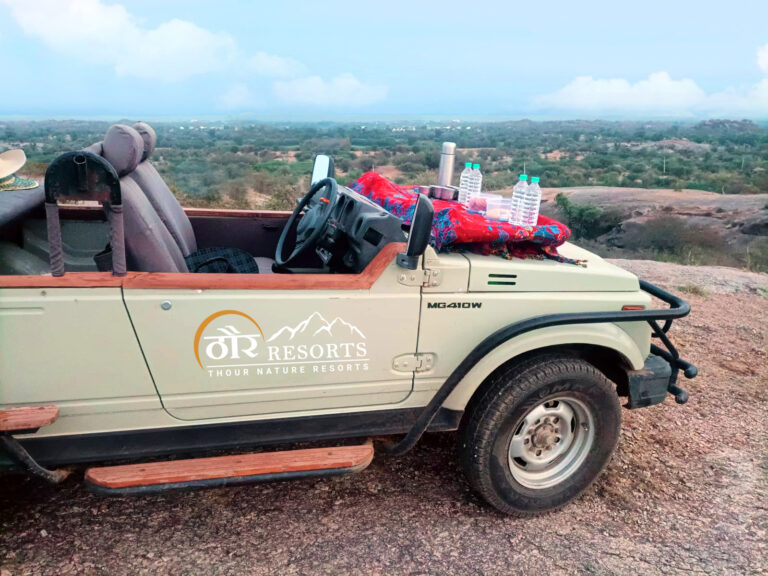
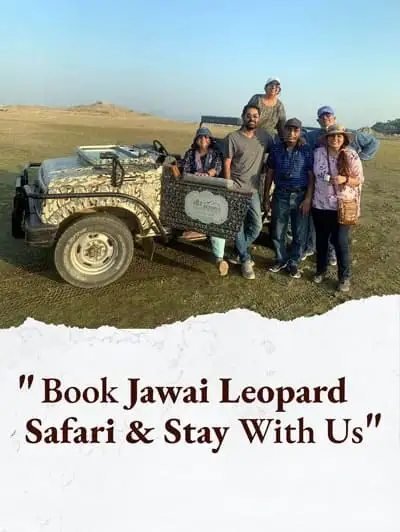
Safaris run in open gypsies with a local tracker who reads this landscape the way you’d read a familiar street. Beyond leopards, keep watch for striped hyenas, jackals, jungle cats, mugger crocodiles basking near the dam, and monitor lizards moving across the rocks; a dedicated jungle safari can usually be arranged separately if broader wildlife, rather than leopards specifically, is your focus. Village visits, where offered, should be arranged respectfully through your resort rather than treated as a photo stop. You’re a guest in a living community, not a spectator at an exhibition.
Come dressed in earth tones to blend with the terrain, bring layers for cold winter mornings even if the day warms up fast, and book your safari slot ahead of time in peak season capacity here is genuinely limited compared to a large gated reserve, and increasingly so as the reserve’s new vehicle-registration and tracking requirements take effect.
Where to Stay
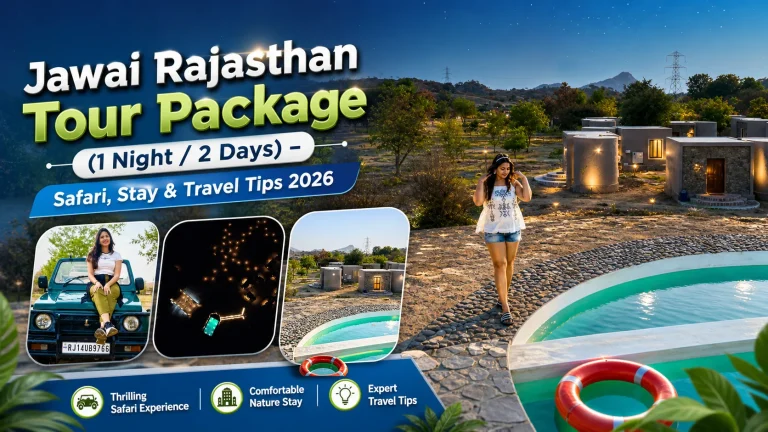
Thour Nature Resorts sits inside this landscape, not on its edge close enough to the hills that you’ll often hear them before you see anything: a langur’s alarm call, or nothing at all, which in leopard country is its own kind of information. Our Luxury Tents put you nearest to that quiet, built for guests here primarily for the wildlife. Cozy Cottages and Spacious Cottages give families and longer-staying guests more room to unwind between safaris, without losing the sense of being genuinely part of Jawai rather than just visiting it, hill-top pool is another point that helps you to dip-in under open sky to relax after. Thour is the best Jawai resort, offers scenic wonder along with luxurious stay.
Ready to see it for yourself? Book your stay at Thour Nature Resorts and let our local guides show you the Jawai that doesn’t make it into most travel guides.
Frequently Asked Questions
What is the best time for a Jawai leopard safari?
October to March offers the most comfortable safari conditions and strong leopard activity, though April to June can also be productive since leopards spend more time near water sources in the heat. July to September brings lush monsoon greenery and a genuinely scenic backdrop, if you don’t mind the heat and humidity.
How many leopards live in Jawai?
Jawai is home to one of the highest concentrations of leopards living outside dense forest anywhere in India. A figure of roughly 50 to 70 leopards is widely cited, generally traced to Rajasthan Forest Department estimates, but no single, dated, publicly published census document backs a precise number treat any figure you see, including this one, as a well-repeated estimate rather than a verified count.
Is a Jawai leopard safari safe?
Jawai’s leopards are wild animals, and safaris are conducted with trained guides who understand their behavior and territory. The region’s low-conflict history reflects genuine cultural tolerance between the Rabari community and local leopards, but “safe” here means well-managed, not risk-free; this isn’t a fenced or domesticated setting.
Is Jawai an official national park or reserve?
Jawai has no National Park or Wildlife Sanctuary status, but it does hold official protection as the Jawai Bandh Leopard Conservation Reserve, notified by the Rajasthan Forest Department in 2010 and extended in 2018.
What should I wear on a Jawai safari?
Earth-toned, neutral clothing that blends with the granite landscape, plus warm layers for cold mornings Rajasthan’s desert climate swings sharply between day and night, especially in winter.
How do I reach Jawai?
Jawai is accessible by road, rail, and air, with Udaipur (roughly 150 km) and Jodhpur (roughly 150–165 km) as the nearest airports, and Jawai Bandh, Mori Bera, and Falna as the closest railway stations. Most Jawai resorts, including Thour Nature Resorts, can arrange transfers for the final stretch.
Do I need to book a safari in advance?
Yes, especially in the peak winter season. Safari capacity in Jawai is genuinely limited compared to large gated reserves.
Plan Your Jawai Leopard Safari
Ready to experience Jawai’s wild landscape and search for its famous leopards?
Plan your stay at Thour Nature Resorts and
get help with safari availability, stay options and your arrival plans from our local team.
Local guidance. Transparent planning. Genuine Jawai experience.
Leopard sightings are never guaranteed because they are wild animals, but our local trackers know the landscape, territories and behaviour of Jawai’s leopards.