 +91-9784559999
 info@thournatureresorts.com
Quick Summary
A jungle safari in Jawai is a wildlife experience in Rajasthan’s Pali district, best known for free-ranging leopards living among granite hills, caves and scrubland. Unlike conventional forest safaris, Jawai offers an open rocky landscape where visitors can also encounter hyenas, nilgai, crocodiles and diverse birdlife.
There are wildlife destinations where you enter a forest to look for a leopard. And then there is Jawai.
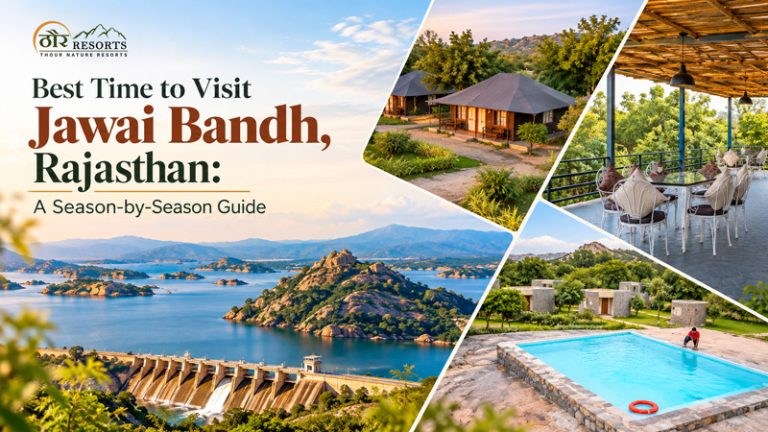
Here, the forest almost disappears. In its place are enormous granite boulders, dry scrub, hidden caves, village paths, grazing livestock and the shimmering waters of Jawai Dam. Somewhere above you, a leopard may be resting on a sun-warmed rock, watching the landscape with the calm confidence of an animal that has lived here for generations.
This is what makes a jungle safari in Jawai so different.
Jawai, in Rajasthan’s Pali district, is internationally known for its free-ranging leopard population and its unusual landscape of rocky hills and caves. The area is officially protected as the Jawai Bandh Conservation Reserve, and the Rajasthan Forest Department currently lists both Jawai Bandh Conservation Reserve and Jawai Bandh Leopard Conservation Reserve II in Pali.
But Jawai is not simply about finding a leopard.
A safari here is an introduction to an entire living landscape; one where wildlife, wetlands, pastoral communities and rugged Aravalli terrain exist remarkably close to one another.
What Makes a Jungle Safari in Jawai Different?
The first surprise is geographical.
Jawai does not look like the stereotypical Indian jungle. Instead of dense sal forests or tall grasslands, the landscape is dominated by ancient-looking granite formations, rocky outcrops, caves and thorny scrub. And this unusual terrain is precisely what makes the region so fascinating for leopard lovers.
Jawai’s leopards use natural caves and crevices in the granite hills as shelter. From elevated rocks, they can survey large stretches of their surroundings. The relatively open terrain can also make them easier to observe than leopards hidden inside thick forest.
This is one reason Jawai has become famous for leopard photography and wildlife safaris. A recent guide from Lonely Planet describes Jawai’s safari experience as distinctly different from India’s conventional national-park model, with local trackers and naturalists helping visitors read the landscape and locate wildlife.
Is Jawai a National Park?
No, and this is an important distinction.
Jawai is not a national park or tiger reserve.
The Jawai Bandh area was notified as a Conservation Reserve in 2010 under India’s wildlife-protection framework. The Rajasthan Forest Department’s current protected-area records list Jawai Bandh Conservation Reserve at 19.79 sq. km and also list Jawai Bandh Leopard Conservation Reserve II.
This matters because Jawai’s wildlife landscape is not simply a fenced-off forest.
Leopards move through a mosaic of rocky hills, scrubland, village surroundings and other habitats. That is also why the Jawai experience feels less like entering a conventional wildlife park and more like entering a functioning landscape where people and wildlife share space.
The Leopard Is the Star But the Landscape Is the Story
Most people arrive in Jawai wanting one thing:
To see a leopard. And understandably so.
The region is known for an unusually high concentration of leopards living in rocky, largely open terrain. Current estimates commonly place the local population in the range of roughly 50-70 individuals, although this should be understood as an estimate rather than a precise, permanent census number.
The remarkable part isn’t simply the number. It is where these leopards live.
They are not dependent on a dense forest canopy. Their habitat includes caves, granite hills, scrub and open rocky country. That creates a completely different safari experience.
Instead of driving through thick vegetation hoping for movement, your naturalist may stop the vehicle and point towards what initially looks like an ordinary rock.
Then someone whispers:
“There.” And suddenly the landscape changes.
The rock has eyes.
How Does a Jawai Leopard Safari Work?
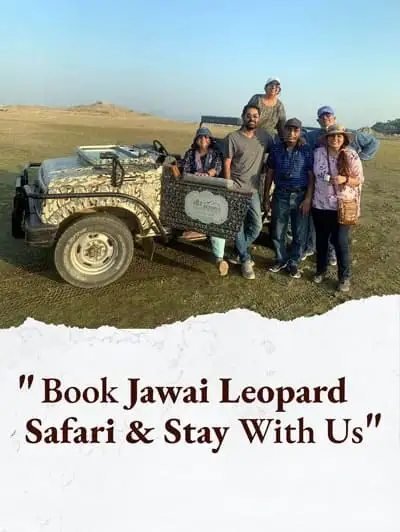
A typical Jawai leopard safari is conducted in an open 4×4 vehicle with a local guide, naturalist or tracker.
Safari drives generally focus on the periods when wildlife is more active, particularly early morning and late afternoon toward sunset. Local safari operators commonly describe drives of around 2.5-3 hours, although timings and duration can vary with season, weather and local operating conditions.
But the most important part of a good safari isn’t speed.
It is an observation.
A trained tracker reads subtle clues:
- pugmarks on a dusty trail
- alarm calls from langurs or birds
- movement around a cave
- livestock behaviour
- fresh tracks
- a leopard’s preferred rocky lookout
- changing light and temperature
In Jawai, understanding the terrain can be just as important as simply driving through it.
Can You Really See Leopards in Jawai?
Jawai offers excellent opportunities for leopard sightings, but no ethical wildlife professional should guarantee one.
Leopards are wild animals. They do not follow a tourist timetable.Their movement depends on temperature, prey availability, disturbance, territory, season and countless other factors.
The open granite landscape does, however, create unusually favourable viewing conditions compared with many dense-forest habitats. Local guides and trackers also build their knowledge around individual animals, territories and regularly used routes.
So the right expectation isn’t; “I am guaranteed to see a leopard.”
It is, “I have a very good opportunity to observe a wild leopard in an extraordinary natural setting.”
That difference matters. It is the difference between a wildlife experience and a staged attraction.
The Best Time for a Jungle Safari in Jawai
Jawai can be visited throughout much of the year, but the experience changes with the seasons.
October to March: Comfortable Safari Season
For many travellers, October to March is the most comfortable period for visiting Jawai. The weather is comparatively pleasant, making early-morning and late-afternoon safari drives much easier to enjoy. Winter also brings increased bird activity around Jawai’s water bodies and wetlands.
December to February: Wildlife + Birdwatching
Winter is particularly appealing if your interests extend beyond leopards. Jawai’s reservoir and surrounding wetlands attract migratory and resident birds, adding another dimension to the safari experience. Species reported in the wider Jawai landscape include cranes, flamingos and other waterbirds.
If birdlife interests you, explore our detailed guide to bird watching in Jawai Bandh.
Summer: Hotter, But Interesting
April to June can be extremely hot in Rajasthan. However, summer also changes wildlife behaviour around available water sources. For experienced wildlife travellers who can handle the heat, this season can offer interesting opportunities for observation.
The key is to plan safari timings carefully and prioritise comfort and wildlife welfare.
For a detailed seasonal breakdown, see our guide to the best time for a leopard safari in Jawai.
Jawai Is More Than a Leopard Destination
One of the biggest mistakes first-time visitors make is thinking that Jawai is a single-animal destination. It isn’t. Look beyond the leopard and the landscape becomes much richer.
Depending on the location and season, a Jawai jungle safari can offer opportunities to encounter or observe:
- Striped hyenas
- Nilgai
- Indian foxes
- Jungle cats
- Sloth bears
- Wild boar
- Chinkara
- Mugger crocodiles
- Resident and migratory birds
The Jawai Dam ecosystem is particularly interesting for birdwatchers, while the rocky terrain provides habitat for a range of mammals.
This is why a slower safari can often be more rewarding than one focused exclusively on finding a leopard.
Jawai Dam: The Water That Changed the Landscape
The story of Jawai’s wildlife cannot be separated from its water.
Jawai Dam was constructed across the Jawai River, with construction associated with the reign of Maharaja Umaid Singh of Jodhpur and completion in the 1950s. It became an important water resource for the region.
Today, the reservoir is much more than a scenic backdrop.It forms part of an ecosystem that attracts wildlife and birds and gives the otherwise dry landscape an important source of water.
Stand quietly near the water at the right time and the experience can shift completely from leopard country to a birdwatcher’s landscape.
The Rabari Connection: The Human Side of Jawai
Perhaps the most fascinating part of Jawai is not the animals. It is the relationship between wildlife and the people who live here.
The region is closely associated with Rabari pastoral communities, whose traditional livelihoods are connected with livestock and the surrounding landscape.For generations, local communities and leopards have occupied overlapping spaces.This does not mean there is never conflict. Livestock losses and habitat pressures are real issues, and conservation cannot be reduced to the romantic idea of perfect harmony.
But Jawai’s long history of coexistence is an important part of its identity and provides valuable insight into how wildlife conservation can intersect with local communities. The landscape itself demonstrates something that is often overlooked in wildlife tourism:
Conservation does not always happen behind a fence.
A Fact Many Jawai Articles Get Wrong
You will often find websites calling Jawai a “national park.” It isn’t. And you will also find claims that leopard sightings are “100% guaranteed” or “99.99% guaranteed.” They aren’t.
Jawai is a Conservation Reserve, not a national park, and no responsible wildlife destination can guarantee that a wild leopard will appear during a particular safari. The Rajasthan Forest Department officially lists Jawai among the state’s conservation reserves.
For travellers, this is actually good news.
The authenticity of Jawai comes from the fact that these are wild animals living in a real landscape, not animals placed in an enclosure for predictable viewing.
What Should You Expect During a Jungle Safari in Jawai?
Do not expect a safari to be a race. Expect silence.
Expect your driver to stop suddenly because a tracker has noticed something you didn’t.
Expect binoculars to become more important than your camera.
Expect to spend several minutes looking at a hill before someone explains why that particular cave matters. And if you are lucky, expect the landscape to reward your patience.
A leopard may appear on a boulder; A hyena may cross the road. A crocodile may lie motionless near the water. A flock of birds may suddenly rise from the reservoir. Or perhaps nothing dramatic happens at all.
That is wildlife.
And sometimes, that uncertainty is exactly what makes the experience memorable.
Jawai Safari for Wildlife Photographers
Jawai is especially attractive to photographers because its terrain often provides dramatic natural backgrounds. Instead of a leopard disappearing behind dense vegetation, you may see an animal silhouetted against a granite ridge, walking along a boulder or resting near the mouth of a cave.
The combination of:
leopard + granite + golden light + open landscape
creates a visual identity that is distinctly Jawai. Early morning and late afternoon are particularly rewarding for photography because of softer light and more comfortable temperatures. But photography should always come second to the animal.
Never ask a driver to chase, crowd or block wildlife for a photograph. The best image is never worth disturbing the subject.
Photographers can also explore our guide to wildlife photography in the Jawai hills.
Responsible Safari: How to Experience Jawai Without Harming It
The future of Jawai’s wildlife depends partly on how visitors behave.
During a safari:
- Maintain a respectful distance from wildlife.
- Never ask the driver to chase a leopard.
- Avoid loud conversations and sudden movements.
- Never feed wild animals.
- Do not attempt to attract wildlife for photographs.
- Follow the instructions of your naturalist and driver.
- Avoid littering.
- Respect village life and local communities.
- Choose tourism operators who value wildlife welfare and local participation.
- Remember that a sighting is a privilege, not a performance.
Jawai has already faced concerns around habitat disturbance and encroachment, particularly because leopard habitat extends beyond a small formally protected area. Conservation reporting has highlighted the importance of protecting caves and rocky habitat from development pressures.
That makes responsible tourism more than a slogan. It is part of the destination’s future.
Why Stay at Thour Nature Resorts for a Jawai Safari?
A wildlife safari is only one part of the Jawai experience. Where you stay can shape the way you experience the landscape.
At Thour Nature Resorts, the idea is to bring together the wilderness of Jawai with a comfortable stay while keeping the destination itself at the centre of the experience. This Jawai resort is located in the Jawai region near Varaval and provides access to the rocky leopard landscape, local villages and surrounding wildlife areas.
For travellers planning a Jawai leopard safari, staying close to the safari landscape means you can spend less time simply travelling to the destination and more time experiencing it. And that matters in Jawai. Because the magic isn’t only found when a leopard appears.
It is found in the silence before sunrise. In the granite hills glowing orange at sunset. In a shepherd moving across the landscape. In birds gathering around the water. In a leopard disappearing silently into a cave.
Explore more about finding a place to stay in Jawai, Rajasthan.
Frequently Asked Questions About Jungle Safari in Jawai
Is Jawai good for a jungle safari?
Yes. Jawai is particularly well known for leopard safaris, rocky landscapes, birdwatching and the opportunity to observe wildlife in a habitat very different from India’s traditional dense forests.
What is Jawai famous for?
Jawai is famous primarily for its free-ranging leopards, granite hills, caves, Jawai Dam, birdlife and the distinctive coexistence between wildlife and surrounding pastoral communities.
Is Jawai a national park?
No. Jawai is associated with the Jawai Bandh Conservation Reserve and Jawai Bandh Leopard Conservation Reserve. The Rajasthan Forest Department officially lists the reserves in Pali district.
What animals can I see on a Jawai safari?
Leopards are the main attraction, but depending on location and season, visitors may also encounter striped hyenas, nilgai, jungle cats, foxes, sloth bears, chinkara, mugger crocodiles and numerous bird species.
What is the best time for a Jawai leopard safari?
October to March is generally considered one of the most comfortable periods for visiting, with pleasant weather and good opportunities for wildlife and birdwatching.
Are leopard sightings guaranteed in Jawai?
No. Jawai has excellent leopard-viewing opportunities, but leopards are wild animals and sightings can never be guaranteed.
How long does a Jawai safari last?
A typical leopard safari is often around 2.5-3 hours, although actual duration can vary according to the safari operator, season and conditions.
Is Jawai suitable for families?
Yes. Jawai can be an excellent family wildlife destination, particularly for families interested in nature, photography, landscapes and wildlife. Children should, however, follow safari safety instructions and maintain silence around animals.
Final Word: Don’t Just Look for the Leopard
The greatest mistake you can make in Jawai is to measure your safari only by whether you saw a leopard.
Of course, seeing one is unforgettable. But Jawai offers something much rarer: a chance to see a big cat living as part of a landscape rather than apart from it.
Here, the leopard belongs to the rocks.
The rocks belong to the hills.
The hills belong to the villages.
And the villages are part of the same landscape as the wildlife.
That is the real story of a jungle safari in Jawai.
Come looking for a leopard.
Leave understanding Jawai.
Plan Your Jawai Safari with Thour Nature Resorts
For travellers looking for a Jawai leopard safari, wildlife stay or nature experience in Rajasthan, Thour Nature Resorts offers a base from which to explore the remarkable landscape of Jawai and its wildlife.
Because in Jawai, the most memorable safari may begin when the engine stops, the guide points towards an ordinary-looking hill, and you realise that the “rock” you have been staring at has been watching you all along.
Jawai isn’t just where you go to see a leopard.
It is where you learn how a leopard lives.
Ready to Explore Jawai?
Experience the unique landscape of Jawai, discover its wildlife and enjoy a memorable leopard safari.