 +91-9784559999
 info@thournatureresorts.com
Quick Answer
The best time to visit Jawai Bandh is October to March, when cooler weather keeps leopards active through the day and migratory birds arrive at the dam in full force. December and January are the sweet spot for birding, while February–March give you milder mornings for longer safari drives.
The first thing that surprises most visitors to Jawai isn’t the leopards, it’s the landscape they live in. No dense jungle, no thick tree cover, nothing you’d typically call “the wild.” Just bare granite hills, weathered into boulders and caves over millions of years, rolling out toward the edge of the Aravallis among the oldest mountain ranges on Earth.
And it’s exactly this openness that makes Jawai one of the most extraordinary leopard-watching landscapes in India: the cats have nowhere much to hide, and the herders below have learned, over generations, to share the rock with them.
That coexistence is the whole story of Jawai.
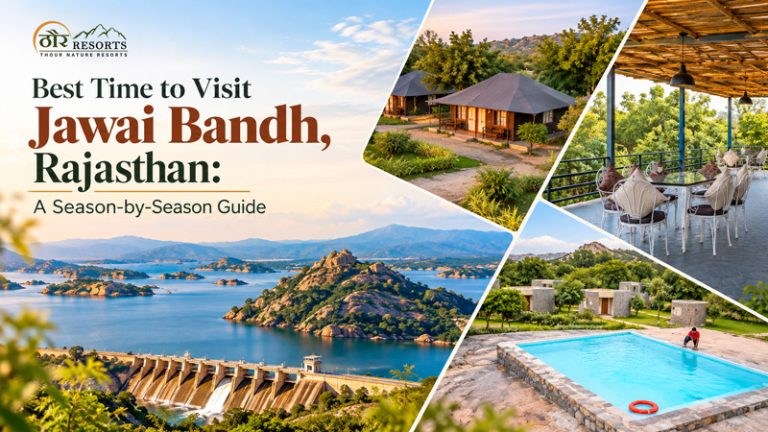
This is a place in the Pali district of Rajasthan, anchored by the Jawai Dam, one of the largest dams in western Rajasthan. Its construction began in 1946 under Maharaja Umaid Singh of Jodhpur and finished eleven years later, in 1957.
Around it lives a dense population of leopards existing not behind fences or park boundaries, but alongside the Rabari, a semi-nomadic pastoral community who consider the leopard sacred linked, in their belief, to Shiva. Worth noting plainly: Jawai isn’t a legally notified national park or wildlife reserve the way Ranthambore is. It’s something rarer; an unmanaged, working landscape where wild predators and human settlement have found an uneasy, enduring truce.
Table of Contents
Best Time to Visit Jawai Bandh
If you’re weighing when to go, the answer is straightforward: October to March. The cooler weather keeps leopards active for longer stretches during the day rather than retreating into shaded crevices, and it’s peak season for migratory birds arriving at the dam. Summers here run brutally hot, so unless you’re chasing pre-monsoon light for photography, the winter window is when Jawai gives you the most comfortable safaris, better wildlife activity, and a landscape at its most alive.
October-March: The most comfortable weather, and peak season for migratory birdlife at the dam; flamingos, cranes, pelicans, and other waterfowl are common sightings.
April-June: Hot, but leopards spend more time near water sources, which can work in your favor for daytime sightings.
July-September: Monsoon greens up the hills beautifully; sightings will still amaze you against the most scenic backdrop of the year.
Safari timings shift with the season, generally earlier starts and later finishes in summer, later mornings in winter. Confirm exact windows with your resort when you book, since these vary by property and year.
| Month | Approx. Avg. Temp |
|---|---|
| January | 17.5°C |
| February | 20.4°C |
| March | 25.4°C |
| April | 30.0°C |
| May | 33.6°C |
| June | 32.5°C |
| July | 29.2°C |
| August | 27.6°C |
| September | 28.0°C |
| October | 27.2°C |
| November | 22.3°C |
| December | 19.1°C |
Within that window, December and January edge out as the sweet spot for birders. The migratory flocks are fully settled in by then, while February and March offer slightly milder mornings for longer safari drives.
We do not guarantee these temperatures as it is nature and may fluctuate without alarm, check before your bookings.
Planning your Jawai trip around the October–March window? Lock in your dates before the peak season fills up.
What Makes Jawai Worth the Journey
A genuine leopard stronghold – one of the highest densities of leopards found anywhere near human settlement in India, with sightings reported often (though, as with all wildlife, never guaranteed).
A landscape unlike anywhere else in Rajasthan – ancient granite boulders and open sky make for dramatic safari terrain, trekking, and photography.
Jawai Dam. One of the largest dams in western Rajasthan, the Jawai Bandh isn’t just an engineering feature, it’s the ecological anchor of the entire region, drawing water, wildlife, and eventually, tourism, into one orbit.
The ancient temples where faith and leopard meet.
Living culture, not a backdrop – the Rabari’s relationship with the leopard is rooted in real spiritual belief, not tourism marketing.
Serious birdlife – nearly 150 to 200 species have been recorded around Jawai Dam, with migratory waterfowl arriving in winter.
Offbeat luxury – a quiet corner of Rajasthan where you can safari by day and unwind into real comfort by night.
Things To Do in Jawai Bandh
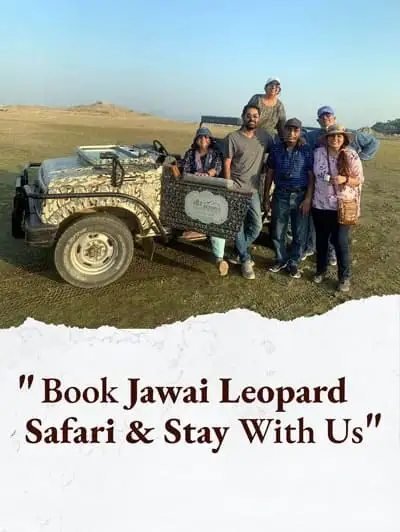
Leopard safari. Dawn and dusk are when the cats move a slow stretch off a sun-warmed rock, a look around, then the unhurried walk to a favored ledge. Guides here track individual leopards’ routines the way you’d know a neighbor’s habits.
Jungle Safari. Beyond its famous leopards, Jawai is home to a wide range of fascinating wildlife. A jungle safari in Jawai allows you to witness the region’s rocky, arid terrain, where you might spot sloth bears, pythons, foxes, hyenas, nilgai, jungle cats, and even wolves.
Jawai Dam Visiting. Built across the Jawai river, Jawai Dam is a peaceful spot where you can relax, meditate, experience a peaceful yoga session, and spend some alone time in nature, and catch beautiful sunrise or sunset views. Photographers and bird lovers will especially love this place.
High – tea on Jawai Hills. Take a break and trade the city noise for forest melodies. There is nothing like experience compared to high tea on Jawai Hills. Surrounded by open skies, granite landscapes, and wild serenity, you will get an opportunity to sip on warm chai or coffee and eat local snacks.
Birdwatching at the dam. Winter turns Jawai’s waters into a genuine draw for serious birders; flamingos, cranes, pelicans, and other waterfowl arrive alongside resident raptors and kingfishers.
Crocodile-spotting. The Jawai River and dam support a notable population of mugger (marsh) crocodiles among the more reliable places in Rajasthan to see them sunning on the banks in early morning or late afternoon.
Temple visits. Dev Giri Temple, a cave shrine occasionally visited by leopards themselves, and Kambeshwar Mahadev Temple both sit at the intersection of faith and landscape that defines this region.
Sunset from the hills. There’s a specific, unhurried quality to watching the sun drop behind Jawai’s granite worth setting aside an evening with no other agenda.
Off-roading and nature walks. Rugged tracks over granite slopes make for genuine adventure driving, while early-morning guided walks are the better way to notice what a jeep drives past animal trails, rock formations, the vegetation clinging to bare stone.
Time with Rabari. Village visits, arranged respectfully through your resort, offer a real look at how a community has built its daily and spiritual life around coexistence with a wild predator, not a photo-op, but a conversation worth having.
Where to Stay
Thour Nature Resorts sits close enough to the hills that you’ll hear Jawai before you fully see it. The alarm call of a langur, maybe, or nothing at all, which in leopard country is its own kind of information. For those building their trip around safari mornings and granite-hill sunsets, the Luxury Tents put you right at the edge of that rhythm.
Travelling as a family or want more room to settle in for a few days? The Cottages and Spacious Cottages give you that same closeness to the wild with a bit more space to spread out.
The pool on the top of the hill under open sky shares majestic views and surroundings, a strange, pleasant kind of déjà vu, watching the same granite ridges from the water instead of a jeep seat.
How to Reach Jawai Bandh
By air: The nearest airports are Udaipur (roughly 135 -150 km) and Jodhpur (roughly 170 -180 km), both a straightforward cab ride from Jawai.
By rail: Mori Bera is the closest station (4-5 km), followed by Jawai Bandh station (14-15 km). Falna, roughly (34 -35) km away, is the major railhead with direct long-distance trains from Delhi, Mumbai, Jaipur, and Ahmedabad.
By road:
- Jaipur to Jawai Bandh: roughly 390-400 km, about 6 -7 hours
- Jodhpur to Jawai Bandh: roughly 147-165 km, about 2h40 -3h20
- Udaipur to Jawai Bandh: roughly 130 km, about 2.5 hours
- Mount Abu to Jawai Bandh: roughly 100 km, about 2h15
Places to Visit Near Jawai Bandh
- Ranakpur (1 hour) – the marble-carved Jain temple complex, one of Rajasthan’s architectural highlights.
- Jodhpur (2h40–3h20) – Mehrangarh Fort and the blue city, worth 2–3 days on their own.
- Nathdwara (2 hours) – the Shrinathji Temple and a towering Shiva statue nearby.
- Kumbhalgarh (2 hours) – the UNESCO-listed fort with one of the longest continuous walls in the world.
- Mount Abu (2.5 hours) – Rajasthan’s only hill station, a cool-air contrast to the desert heat.
Travel Tips
- Book your leopard safari through your resort, local guides know individual leopards’ patterns far better than any app can.
- Pack for temperature swings: warm layers for dawn safaris, sun protection for midday, and binoculars for both leopards and birds.
- Keep a respectful distance from wildlife at all times, and follow your guide’s instructions, these are wild predators, not tame ones.
- Ask before photographing Rabari community members, and dress modestly during village visits.
- Check age and safety guidelines for safaris directly with your resort, since these vary.
FAQs
What is the best time to visit Jawai Bandh?
October to March, for cooler weather, active leopards, and peak migratory birdlife. December and January are especially strong for birding.
Which state is Jawai Bandh in?
Jawai Bandh is in the Pali district of Rajasthan, near Sumerpur town, built across the Jawai River.
How many leopards live in Jawai?
Exact counts vary by survey, but Jawai is widely recognized as home to one of India’s highest densities of leopards living outside a formally protected reserve.
Is Jawai Bandh an official wildlife reserve?
No, despite the name sometimes being used loosely in tourism content, Jawai has no legal national park or sanctuary status.
What’s the nearest railway station to Jawai Bandh?
Mori Bera is closest (4-5 km), followed by Jawai Bandh station (14-15 km). Falna, roughly (34 -35) km away, is the major railhead with direct long-distance trains from Delhi, Mumbai, Jaipur, and Ahmedabad.
Ready to Plan Your Jawai Trip?